Guajiru, Ceara Brazil

Updated: Apr 17
A working coastline shaped by wind, fishing, and a changing economy
Guajirú is not remote. But it functions as if it were.
The village sits on Brazil’s northeastern coast, in the municipality of Trairi, Ceará — about 130 kilometers west of Fortaleza. The drive out is straightforward. The transition is not.
As the road leaves the city behind, the landscape simplifies. Vegetation thins, sand begins to dominate, and the horizon opens. By the time the coast appears, the environment is already defined by two elements: exposure and wind.
Guajirú doesn’t announce itself. It becomes apparent through absence.
There are no large buildings, no defined commercial center, and no visible density. The village is spread out — small houses, pousadas, a handful of restaurants — all operating within a low, horizontal landscape.
Nothing interrupts the coastline.
And nothing needs to.
Nothing moves fast here — not even time.

Fishing still structures daily life
Before sunrise, jangadeiros move their boats across the sand and into the water. These are wooden sailing rafts — simple, functional, adapted to this coast over generations. They operate without engines, relying on wind, tide, and experience.
There is no redundancy in the system.
No excess capacity.
Departure is timed.
Return is uncertain.
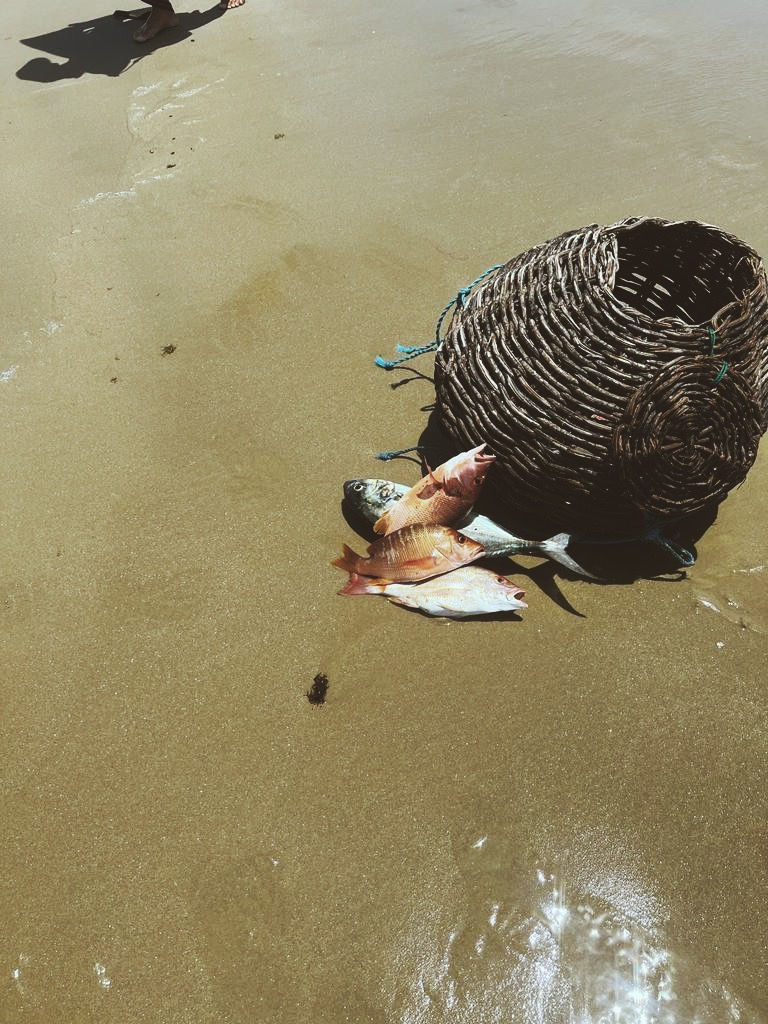
By mid to late afternoon, the boats come back in. The catch varies, but typically includes lobster, fish, shrimp, and crab. Much of it enters the local economy immediately — sold, prepared, or consumed within hours.
This is not a preserved tradition.
It remains active infrastructure.
Fishing remains central to the village.

Over the past two decades, a second system has developed on top of the first — built on the same conditions.
Ceará has become one of the most consistent kiteboarding regions globally, driven by seasonal trade winds that intensify between July and December. Wind speeds regularly reach 20–30 knots, creating predictable conditions along hundreds of kilometers of coastline.
Guajirú sits directly within that corridor.
Residents work as instructors, assistants, drivers, and hosts. Younger generations grow up with direct access to the sport, learning early and frequently.
This proximity to consistent conditions has shaped what is often referred to as the Brazilian style of riding — less rigid, more adaptive, technically strong but not mechanical.
The difference is not stylistic branding.
It is exposure.
In Guajirú, wind is not a session.
It is a constant during july till november
But unlike larger kite destinations, its development has been incremental.

People sit outside their homes. Chairs move into the street. Conversations extend across open space. Children circulate freely. There is no formal boundary between private and communal life.
This is not staged.
It is the default configuration.
And it persists, largely because it has not yet been displaced
Community & Values
Beyond the water, the village holds onto something deeper. Brazilian Jiu-Jitsu is taught to children — often freely. Religion is present, quietly but consistently. Catholic traditions blend with growing evangelical communities. Festivities mark the calendar. Among them, the day of Nossa Senhora dos Navegantes — a reminder of the ocean’s central role.

At night, the streets don’t empty. They fill. People sit outside their homes. Conversations stretch across sidewalks. Children move between houses. Life remains visible — shared, unfiltered. There is no rush to go inside.
The village doesn’t close — it breathes.
Culinary Traditions
Food follows the same logic as the rest of the system: proximity and constraint.
Seafood dominates. Lobster season peaks around August, though the local variety is smaller and more delicate than those found in colder waters. Crab, fish, and shrimp are widely available, often sourced locally and prepared with minimal processing.
Fruits — mango, cajú, coconut — come from nearby areas, depending on season.
Menus are not built for diversity.
They reflect availability.
The Case
What distinguishes Guajirú is not isolation, but proportion.
Tourism is present and growing, but it has not yet displaced the village’s original structure. The economy has diversified without fully transitioning. The physical environment remains low-density. Social patterns remain intact and visible.
This balance is unstable.
Other coastal towns in Ceará have followed a different trajectory — increased development pressure, higher land values, and a clearer shift toward tourism-driven economies. Guajirú currently exists at an earlier stage in that process.
That position is not accidental.
But it is not permanent either.

For visitors, the experience is defined by conditions rather than programming.
There is wind — consistently.
There is space — uninterrupted.
There is infrastructure — but limited.
And there is a local population whose daily life does not reorganize itself around tourism demand.
Guajirú does not present itself.
It operates within its own logic, shaped by environment, habit, and gradual change.
What you see is not curated.
It is already in motion.


Comments