Advanced Kiteboarding in Brazil What Progression Actually Looks Like

Updated: Apr 17
There is a version of a kite trip where you ride every day, feel the wind, enjoy the water, and come home roughly the same rider you were when you left.
And there is another version.
The difference is not talent. It is not the destination. It is not even the number of hours on the water. The difference is whether you are in the water, or working in the water.
Most riders never experience the second version. Not because they lack commitment — but because no one ever designed the environment for it.

The problem with most kite trips
When independent riders travel to a wind destination, the structure is usually the same: wake up, check the wind, get on the water, ride until tired, repeat.
That works. It is enjoyable. But it produces a specific kind of rider — one who is comfortable within their existing range and gradually, almost imperceptibly, stops expanding it.
The technical ceiling gets hit not because the rider lacks ability, but because there is no external pressure, no structured feedback, no deliberate practice. Just repetition of what already works.
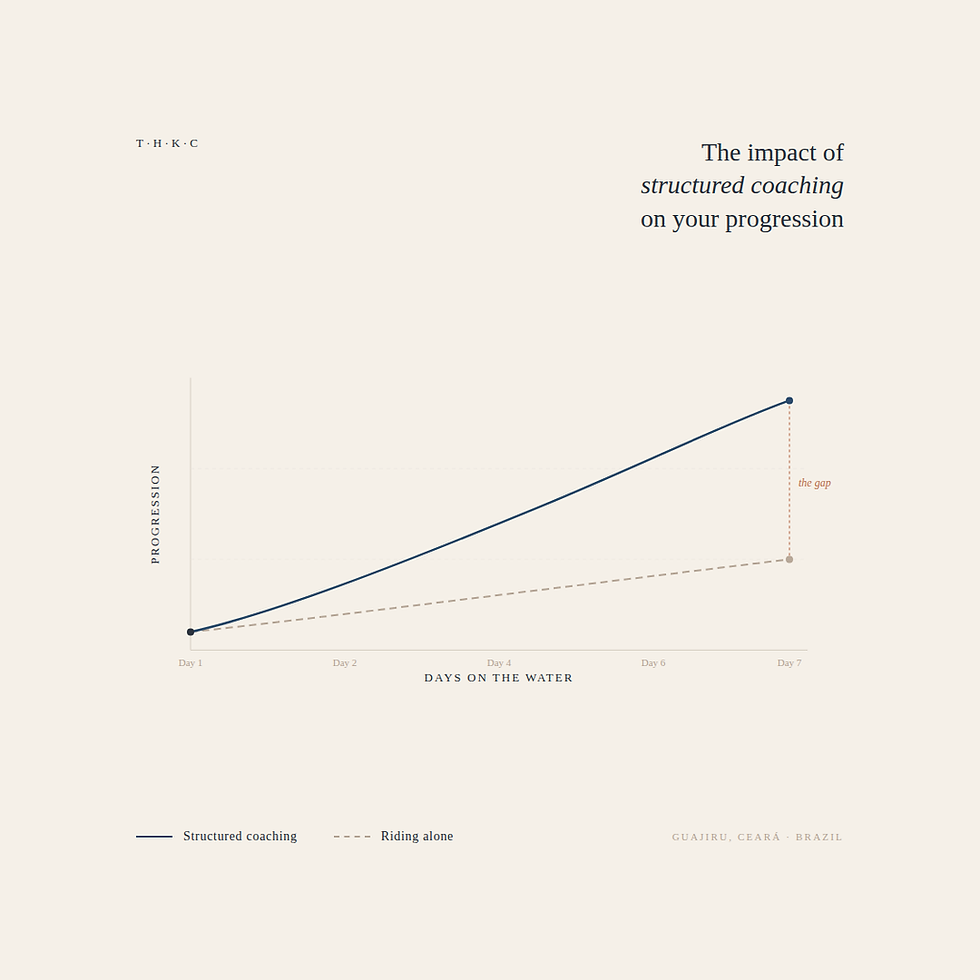
Seven days of that produces seven days of good riding. It does not produce progression.

What deliberate progression looks like
At THKC, coaching and supervision for riders with their own equipment is included in the stay. Not as an add-on. Not as an optional extra. As part of the design of the week.
This is not common in kite travel. Most camps offer lessons for beginners and leave independent riders to their own devices.
THKC operates from a different premise: that an experienced rider with structured coaching improves faster in one week than in months of solo riding.
The programme built around this premise has six pillars.
Mobility
The day begins before the water. Morning mobility and yoga sessions prepare the body for the demands of riding — hip flexors, shoulders, thoracic rotation, balance. Kiteboarding is physically asymmetric and repetitive.
Riders who ignore preparation accumulate fatigue and small injuries that compound across the week. Riders who prepare ride better on day six than on day one.
Understanding
Before entering the water each session, there is a coaching conversation. Wind direction, conditions, spot selection, individual goals for the session. The rider knows what they are working on before they unpack their kite. This sounds simple. In practice it changes everything — because it transforms a ride from a leisure activity into a practice session with intention.
Drilling and visualization
Specific technical movements are broken down, isolated and practiced — both mentally and physically. Visualization is a tool used by high-performance athletes across every discipline. In kiteboarding it is almost never applied. At THKC it is a standard part of session preparation.
On-land coaching
Body mechanics, edge control, kite positioning, pop timing — these are analyzed and corrected before the rider hits the water. Fixing a technical error on land takes minutes. Trying to fix the same error mid-session, in wind and chop, takes days.
Water coaching
Active feedback during sessions. Not supervision from the beach — real-time observation, communication and correction in the water. A coach watching from shore sees a different rider than the rider feels themselves to be. That external perspective is the most valuable thing in progression, and the thing most kiters never have access to. Video analysis
Sessions are recorded and reviewed. Watching yourself ride is uncomfortable and illuminating in equal measure. The gap between what a rider thinks their body is doing and what it is actually doing is almost always significant. Video closes that gap faster than any other tool.
The terrain as classroom
The coastline of Ceará is not just a backdrop. It is an active part of the progression structure.
The lagoon provides flat water, shallow depth and controlled conditions — the ideal environment for technical drilling. Edge control, transitions, toeside riding, body dragging precision. When the technical foundation is solid, the lagoon sessions build it.
Downwinders are where application happens. Riding from one point to another along the coast — often at sunset, always adapted to the group — demands that everything learned in the lagoon gets applied in real, moving, unpredictable conditions. Distance, flow, confidence, reading the environment. For many riders, the first real downwinder is the moment the sport reveals a dimension they had not seen before.
Wave riding introduces the third dimension. The ocean in front of Guajirú offers long, clean lines when conditions allow. Wave riding on a kite requires timing, patience and a fundamentally different relationship with the kite than flat water riding. For riders who have only ridden flat water, it is like learning a new sport that uses the same equipment.
Foiling — both kite and wing — extends the progression into the most technically demanding territory the sport currently offers. Hydrofoil riding rewards precision above everything else. Small errors in body position, edge angle or kite control are immediately amplified. The lagoon in Ceará, with its consistent wind and shallow flat water, is one of the best foil learning environments in the world.

New skills as new toys
There is a useful way to think about technical progression in kiteboarding that has nothing to do with competition or ego.
Every new technical domain — a new riding direction, a new discipline, a new type of water — is a new toy. Something that did not exist in your experience of the sport before, and now does. The water does not get smaller. It gets larger.
A rider who arrives knowing only one direction on one type of water and leaves with three new capabilities does not just ride better.
They have a fundamentally different relationship with the sport. Every future session, in any location, in any conditions, is richer.
That is what structured progression produces. Not performance for its own sake. A larger world.
What a progression week at THKC actually delivers
Seven days. Consistent wind. A structured programme. A coach in the water.
By day three, most riders have identified two or three specific technical elements they want to work on.
By day five, they have made measurable progress on at least one. By day seven, they have experienced at least one session that felt qualitatively different from anything they had experienced before.
That is not a claim. It is the consistent pattern of what happens when deliberate practice meets ideal conditions.

Who this is for
Everyone who comes to ride.
If you're a beginner, this is where your first days on the water happen the way they should — with structured kite lessons in flat water, constant wind, and an instructor whose full attention is on you, not on managing a crowd. The lagoon sessions, the coaching methodology, the video analysis — it all applies from lesson one.
Learning to kite is not a lesser version of the programme. It is the programme. The same environment that accelerates an advanced rider's progression is what makes a beginner's first waterstart feel inevitable rather than accidental.
If you're an intermediate rider who can go upwind but feels stuck — transitions aren't clean, toeside is shaky, you've been at the same level for two seasons — this is where the ceiling breaks. Structured coaching identifies what your body is actually doing versus what you think it's doing. The flat water gives you a clean lab to drill it. The ocean gives you the conditions to apply it.
If you're advanced — you travel for the sport, you've been riding for years, you genuinely love it — and you've hit the invisible plateau that solo riding produces, this is where that changes. The wind is there every day. The structure is there every session. Downloops, unhooked, board-offs, wave riding — whatever you're circling, a coach in the water and video on the beach close the gap faster than another year of solo sessions ever will.
The point is not that THKC serves one type of rider. The point is that the ecosystem — lessons, coaching, flat water, ocean, downwinders, video, daily structure — works as a single system.
A beginner taking their first lesson and an advanced rider drilling unhooked tricks are both progressing inside the same designed week. The only variable is where you enter.
Ceará in July - till october is the right place. The wind is there every day. The question is whether you show up ready to work.
Kite Week Brazil runs July – October 2026. Coaching and supervision included for riders with equipment. → Check dates


Comments