The Wind in Ceará

Why it blows, when it blows, and what it means
There is a question that comes up early in every conversation about Ceará: is there wind?
The honest answer is that asking if there is wind in Ceará is like asking if there is sand in the Sahara. Wind is not a seasonal event here. It is the organizing principle of the territory — the reason the village exists, the reason the jangadeiros built their sails the way they did, the reason the dunes shift, the coconut palms bend permanently westward, and the coast looks the way it looks.
But that answer, while true, is not useful. What follows is the useful version.
The Engine: Trade Winds
The wind that blows along the Ceará coast is not local weather. It is a planetary system.
The Alísios — the Southeast Trade Winds — are born over the South Atlantic, generated by the pressure differential between the equatorial low and the subtropical high. They cross the ocean from east to west, picking up moisture and speed, and arrive at the northeast coast of Brazil with a consistency that is difficult to overstate.
These are the same winds that carried Portuguese caravels to Brazil in the sixteenth century. The same winds that pushed the slave trade routes between the Gulf of Benin and Bahia. The same winds that the jangadeiros of Ceará have read, trusted, and feared for three hundred years.
In practical terms: the Alísios blow side-onshore from the east-southeast. They arrive from the open Atlantic without passing over land, buildings, mountains, or anything else that would create turbulence. The result is a clean, laminar wind — steady in direction, steady in intensity, free of gusts and holes.
Kitesurfers who have ridden in the Mediterranean, the North Sea, or the lakes of Europe will notice the difference immediately. The wind here does not fight you. It does not change its mind.
The Season
The Alísios blow year-round to some degree, but they reach their full operational strength from **July through November**. This is the THKC season, and it is not arbitrary — it follows the wind.
July The season opens. Wind builds through the month. Typical range: 18–22 knots. Mornings can be lighter, afternoons reliable. Good for all levels. Water is at its warmest.
August The engine is running. 20–25 knots daily is standard. Wind arrives early — often by 09:00 — and holds until sunset. This is when the coast feels fully alive. For our opinion This is the Best Month
September — October 22–29 knots is common. Six to seven rideable days per week. Strong winds every day- bigger waves.
November Still strong, beginning to taper slightly toward month's end. Excellent conditions with fewer crowds on the coast.
In other words: if you come between July and November, you will ride. Not most days. Every day.
The Daily Pattern
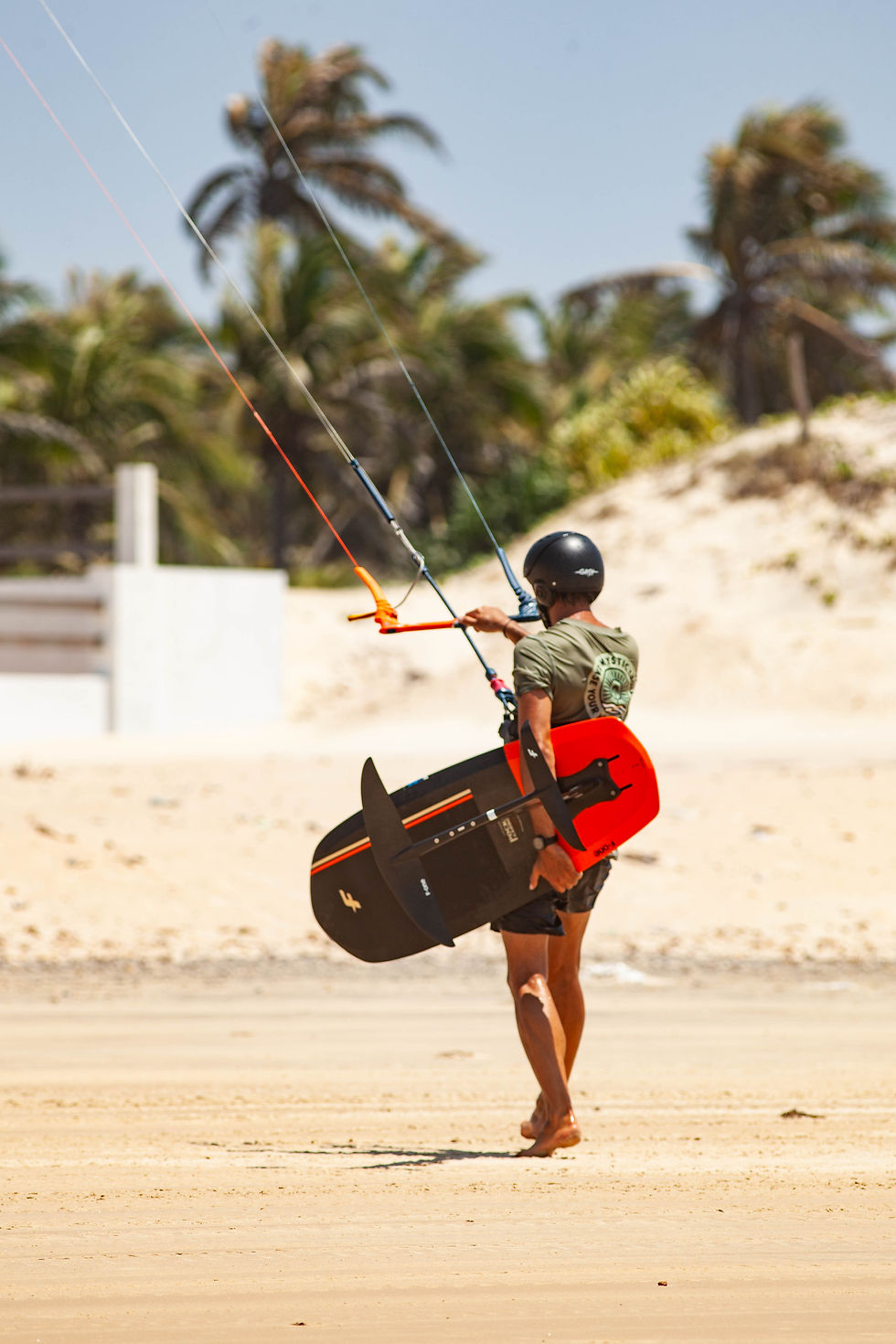
The Alísios follow a predictable daily rhythm that organizes life in Guajirú the same way it has organized coastal life in Ceará for centuries.
08:00 Calm. This is when the fishermen go out — before the wind complicates the water. The ocean is glassy. Coffee, briefing, preparation.
09:00 – 11:00 The wind wakes up. It builds gradually from 12–15 knots. Beginners and foilers go out. The kites start to appear.
11:00 – 16:00 Full power steady, side-onshore. This is the main session window. The water is choppy at sea, flat in the lagoons and river mouths. Downwinders launch in this window.
16:00 – 18:00 The wind holds but begins to soften slightly. Golden light. The best hour for photography, the best hour for a final run. Riders who want calmer water wait for this.
18:00 – 19:00 Wind drops. Sunset. The ocean settles. The second calm of the day mirrors the first.
This pattern repeats with remarkable consistency, day after day, week after week. It is not weather. It is rhythm.
What This Means for Your Riding
Kite sizes Leave the big kites at home. The standard quiver in Ceará is 7m–10m for an 80kg rider. A 12m is a backup for the rare light day. If you ride a 9m comfortably in 22 knots, you will use it almost every session.
Direction: Side-onshore from the right (when facing the ocean). This means the wind pushes you gently toward shore — not out to sea. It is the safest possible wind direction for open-water riding. No rescue boats needed. If something goes wrong, you drift to sand, not to the horizon.
Water temperature: 26–28°C year-round. No wetsuit. No boots. Board shorts and a rashguard. The water is warmer than most swimming pools in Northern Europe.
Density note: Because of the tropical heat (30–35°C air temperature), the air in Ceará is less dense than in cooler climates. A 22-knot day here feels roughly equivalent to 18–19 knots in France or the Netherlands. This is good news — it means the wind is powerful enough to ride but forgiving on the body. You will last longer in a session here than you expect.
Variety of water: Within a 15-minute drive of the villa, you have open ocean (chop and small waves), a river mouth (flat water, waist-deep), a lagoon (mirror flat, knee-deep), and the downwinder coast stretching in both directions. The wind is the same everywhere. The water changes everything.

Why It Matters Beyond Kiteboarding
The Alísios are not a convenience for sport. They are the historical infrastructure of this coast.
The jangada — the traditional fishing raft of Ceará — was designed specifically around these winds. Its triangular Latin sail catches the Alísios at the precise angle needed to sail against the current and return from deep water with the day's catch. Without the Alísios, the jangada does not work. Without the jangada, the fishing villages of the Ceará coast — Guajirú among them — do not exist.
The wind turbines that now line the dunes behind the beach are the modern version of the same principle: the territory converting wind into livelihood. From sail to turbine, the logic has not changed in three centuries.
When you ride in Guajirú, you are not borrowing a natural resource. You are joining a system that has organized human life on this coast since before anyone thought to call it a sport.
The wind in Ceará does not arrive. It lives here.
— Archives


Comments